The Infamous OBT | Russo Reviews

Pterinochilus murinus, the Orange Baboon Tarantula, the P-Terror, the Orange Bitey Thingy

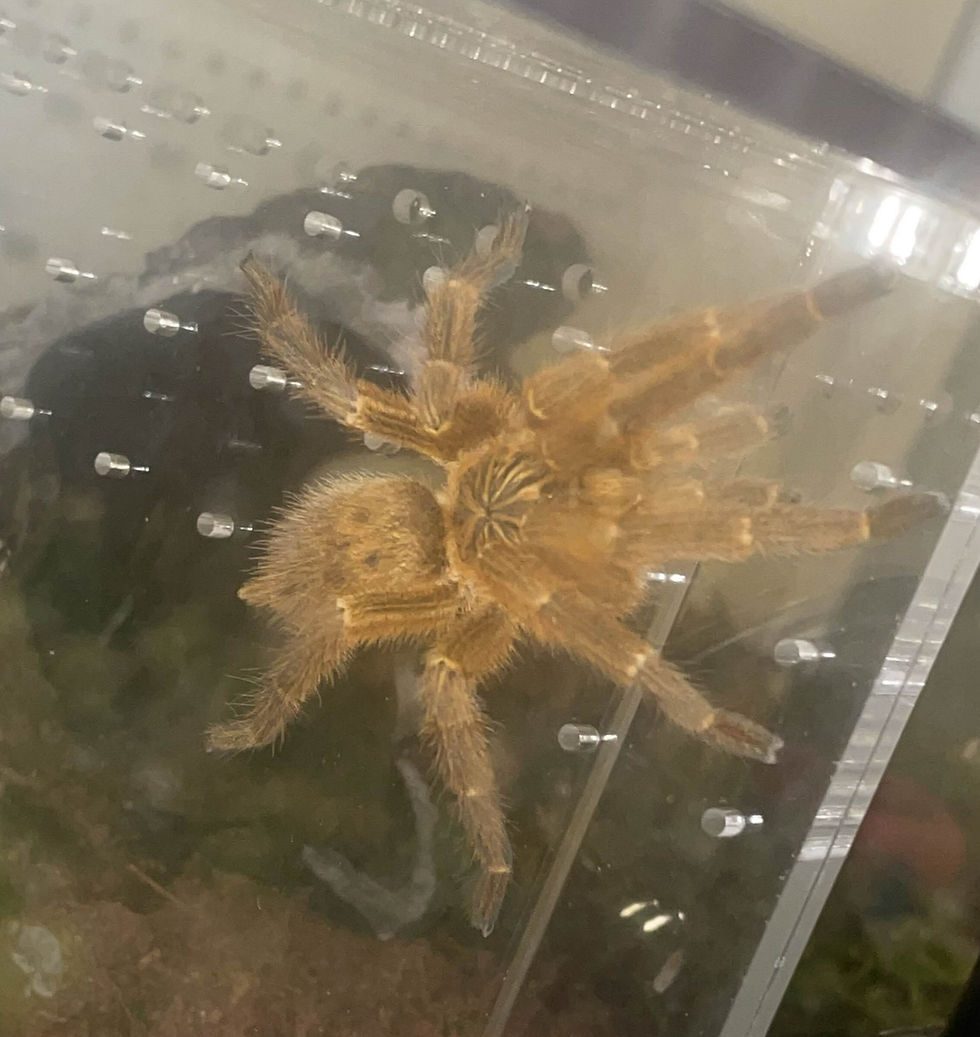
The notorious OBT strikes awe (or fear!) into experienced keepers due to their extravagant orangey-yellow coloration, their beautiful and intricate webs, and their trademark defensive attitude. Do these little guys deserve their reputation? I'll dive into that and so much more in this Russo Review, where I review tarantula species based off my own experiences.
STATS:
Latin/Scientific Name: Pterinochilus murinus
Common Name: Orange Baboon Tarantula (OBT)
Living Style: Semi-Arboreal
Endemic: Vast regions across Eastern and Southern Africa
Urticating Hair Intensity: N/A
World Type: Old World
Venom Potency: High
Stereotypical Temperament: Feisty
I've only had one OBT in my collection to date, named Luigi which I got in September of 2023. Despite adamant disapproval, the OBT was my first Old World tarantula species. I figured however, if I got an OBT as a sling (less than one inch in this case) for a crisp Andrew Jackson, that my experience with it would grow as the spider did. This ended up being the right call as I was quickly shown why the OBT has such a reputation. To top off my many mistakes with this species, my first mistake was attempting to tong-feed. This was of course, a terrible idea. Tong-feeding only really works with certain species of tarantulas in niche scenarios, such as attempting to feed a female guarding an egg-sac. There is no reason to hold live prey in place for a fast, unpredictable tarantula with potent venom.

As expected, the tarantula took the opportunity and bolted straight up my tongs towards me. Fortunately, I dropped the tongs before he could run onto my hand, but to my horror when I checked the floor where my tongs had fell the OBT was nowhere to be seen. Now, I had an even worse situation on my hands. I quickly blocked any means of escape, under my door and my vent, and took out my phone flashlight. After about five minutes, I found the sling in the back corner of my room between my desk and my wall. Clearly, this OBT was out for five minutes more than I wanted it to be, and I quickly caught him with a catch cup and returned him to his enclosure. Never again would I attempt to tong-feed a tarantula, (except in the aforementioned niche circumstances) and the fact I still did up to this point was a little more than worrying.
My second mistake with the infamous OBT was an improper enclosure setup. To start, I will put it blank, these are by no means terrestrial tarantulas. That being said, they aren't arboreal either, hence their classification as "sub-arboreal" by some keepers. This means putting the OBT in a run-of-the-mill terrestrial enclosure, but with some added height so the OBT has room to web.

These guys are pretty prolific webbers if you allow them to, and one of the best parts about OBTs is that no two are the same. Some will erect massive web curtains and floating silk tunnels, adopting a more arboreal lifestyle, while some will create web tunnels on the ground or even burrow. Through the three enclosures he was housed in throughout his life, I saw him make an above-ground web tunnel, to a more arboreal setup, and then finally a mixture of a burrow and above-ground web tunnel. In addition, these little guys grow freakishly fast, my OBT went from an approximately three-fourths of an inch sling to a three-inch mature male in only eight months. I have never seen a tarantula molt so frequently, and at a point Luigi was molting once roughly every fifty days. They have ferocious appetites and I've really never seen an OBT deny a meal except being in premolt. They are also very eager to take on prey items much larger than themselves, characteristic of many Baboon tarantulas. My OBT was eating small superworms at only an inch-an inch and a half DLS, which is absolutely monstrous. Another variable that inexperienced keepers believe is constant is an OBT's ferocity. Of course, OBTs are an Old-World species of tarantula, and therefore have medically significant venom and should not be taken lightly. While they do have a reputation for being quite defensive, quick to throw up a threat-posture and potentially bite, it must be reminded that this is not the case for every single OBT. Each tarantula, like a person is its own living being, each with their own personality and temperament. There are, in fact, as much as

people wouldn't want to believe it, OBTs that are considered "docile." Now, this is of course extremely rare, but it is never out of the question that you may be blessed with a P. Terror that's more like a P. Timid, but it isn't always the case. Something to note with Pterinochilus murinus is although they may be quick to rear up and show off their big ol' fangs to you, they're just as quick to put that threat posture down. The second an OBT is removed from their web/burrow, I've noticed there is an immediate change in their attitude. It's almost like the OBT realizes their home has been compromised, and as they are removed from the web don't see a reason to continue the fight. Obviously, this is not a free ticket to do-whatever you want with them, as that's more akin to a free ticket to the emergency room. However, you can rest assured such as potentially during a rehousing once they are removed from the web, they'll be calmer tenfold. Another way to mitigate the notorious OBT spiciness is to provide them with (as aforementioned) a more semi-arboreal enclosure. Giving the OBT some space between the top of their web and the enclosure lid can lead to the tarantula feeling more secure, and as a result opting to retreat to the safety of their burrow/web tunnel than stand their ground. My OBT really only threw up a threat pose around four times (if I remember correctly!) and only one time did he slap the ground repeatedly and stridulate¹. This was of course, his last stand before he was sent off to a friend for a breeding project. As noted above, once he was placed in the catch cup, away from his enclosure and web, his demeanor completely changed, and it was almost like his "evil switch" was turned off. OBTs are some of the most common and easily bred species in the
hobby, being cheap and readily available at pretty much every online store and reptile show. Now this ease of access is no invitation to add an OBT to your collection if you're not ready, and if the idea of rehousing an orange-bitey-thing or merely the thought of having one gives you goosebumps, it's best to leave the OBT out of your collection. Don't get me wrong, these are gorgeous, wonderful spiders that reward their keeper with their beautiful webs, fierce feeding responses, and trademark yellowy-orange color and attitude; but they are considered an advanced species. This advanced species classification is definitely warranted, with their fast speed, typically defensive nature, and not being hesitant to bite. Their bites are considered medically significant as well, and a bad bite from an OBT can land a person in the hospital. That being said, bites are never a guaranteed, and a more of an "if condition" rather than a "when condition." If a keeper is responsible and experienced, there is relatively no room for issues outside of rehouse and transport.
If you feel you are ready for the OBT, then I could not recommend enough adding one to your collection. My final Russo Review rating for the Pterinochilus murinus or OBT, is a four out of five stars.
These gorgeous grumpy cheeto-puffs are extremely satisfying to raise and keep. They are considered one of the hobby's "staple tarantulas," or tarantulas that are in almost every keeper's possession. They are readily available as aforementioned and cheap as well. Of course, never let these attributes lure you into purchasing an OBT before you're ready. Keeping some green in your pocket and no spider is always better than a trip to the hospital and or loose OBT in the house.


Glossary
1 - stridulate
A defensive display by some species of tarantulas by rubbing the fangs together, producing a hissing sound.
Comments